
Click here to read the full story
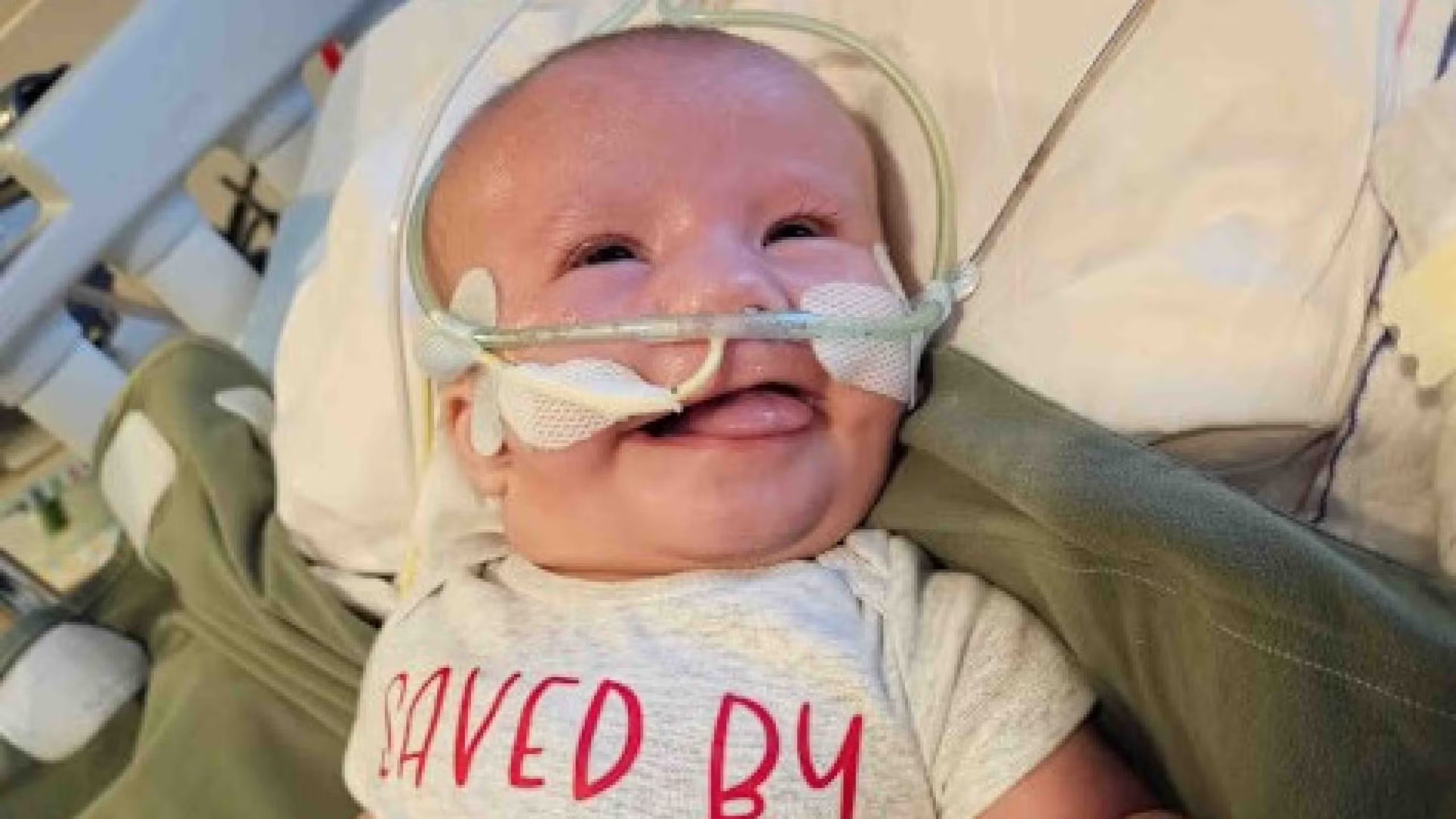
When Lennox was born with a life‑threatening heart condition, his care required highly specialized expertise and close coordination across pediatric cardiology, cardiac surgery, and transplant teams. Through collaboration between Fairview care teams and M Physicians specialists, Lennox became the first infant in the Upper Midwest to receive a partial heart transplant—an advanced procedure performed only a small number of times nationwide. From diagnosis through surgery and recovery, teams worked seamlessly across disciplines to deliver complex, life‑saving care.
Lennox’s experience reflects how academic medicine and community‑based care come together to expand what’s possible for patients and families. By pairing leading‑edge research and surgical innovation with coordinated system support, Fairview and M Physicians are helping ensure that even the most advanced treatments are accessible to patients across Minnesota—without families needing to leave their communities to receive world‑class care.
_________________________________________________________________________________
For the Staricha family of Big Lake, Minn., a small heart-shaped birthmark has become an unexpected symbol of hope.
Their 2-year-old son, DeLuca, had the mark on his arm. Later, his baby brother Lennox arrived with a rare and life-threatening congenital heart defect called Dextro-Transposition of the Great Arteries (D-TGA).
To save Lennox’s life, the care team at the Pediatric Heart Center at M Health Fairview Masonic Children’s Hospital performed the health system’s first partial heart transplant — a groundbreaking procedure carried out fewer than 60 times in the United States.
Lennox’s journey began months before he was born
A life-changing diagnosis during pregnancy
Dusty Staricha and Roxann Martin first learned about Lennox’s condition during the 20-week anatomy scan. D-TGA affects about 1 in every 4,000 live births. In babies with D-TGA, the heart’s two main arteries are switched, causing oxygen-poor blood to circulate through the body and oxygen-rich blood to loop back to the lungs. Without surgical intervention, the condition is fatal.
“It was terrifying to receive that news,” Roxann said. “We had never heard of this condition, and all we wanted was for our son to be safe and healthy.”
Doctors prepared carefully for Lennox’s arrival on Aug. 20, 2025. Lennox was to have open-heart surgery shortly after birth to switch the arteries to the usual positions – the standard way to correct D-TGA. But just before the operation, an echocardiogram revealed a complication: Lennox’s pulmonary valve and the pathway out of the left side of his heart were far too small. The repair would not work.
A milestone surgery in the Upper Midwest
Lennox’s care team at Masonic Children’s Hospital, a nationally recognized leader in pediatric heart care, had to quickly rethink their approach. Lennox’s heart muscle was healthy, but his heart valves needed to be replaced. Standard replacement options — artificial valves or valves from a cadaver — would not grow with him, meaning he would face multiple surgeries throughout his life.
Instead, surgeons recommended a partial heart transplant, using living donor heart tissue to reconstruct the valves so they could grow along with Lennox.
A match was found after 59 days on the transplant list. On Nov. 11, surgeons successfully performed the pediatric partial heart transplant — the first of its kind in the Upper Midwest.
The procedure not only saved Lennox’s life but also opened a new pathway for young patients across the region facing complex congenital heart defects once considered nearly impossible to treat long term.
“I think this procedure represents the future of care for babies born with complex heart disease — it’s a game changer,” said Pranava Sinha, MD, a congenital cardiac surgeon with M Health Fairview and professor at the University of Minnesota Medical School. “By using living tissue that can grow with the child, we have the potential to dramatically reduce the number of surgeries these patients face over their lifetime. We’re proud to offer it to our patients and their families.”
A partial heart transplant may be used to treat conditions affecting the aorta, atrial valve, mitral valve, and pulmonary valve, with potential applications expanding in the future.
The approach also offers additional advantages, including a reduced need for long-term immunosuppressant medications, which can have serious side effects. In some cases, it may also allow more patients to benefit from a single donor heart, as the heart muscle could be transplanted into one patient while the valves help another person whose heart muscle is healthy.
A quiet reminder of how far they’ve come
Lennox’s recovery has been long but rewarding. Today, he continues to work through feeding and developmental challenges common for babies who endure long hospital stays. But the most important measure of progress is clear: his heart is functioning well, and it is growing.
For the Staricha family, the journey has been marked by both fear and profound gratitude; both for the donor family who made the transplant possible, and for the medical team who refused to give up when the original plan fell apart.
As Lennox has recovered and grown stronger in the months since surgery, his brother DeLuca’s heart-shaped birthmark has slowly faded; a quiet reminder to the family of how far they’ve come.