
Click here to read the full story
Walter Byrd’s experience as a COVID‑19 survivor reflects one of the most challenging moments in modern healthcare. After spending 59 days on life support, his recovery was made possible through the dedication of M Physicians and Fairview care teams working across Fairview hospitals—combining critical care expertise, research‑informed treatment, and compassionate support.
The experience also reflects how Fairview and M Physicians have long worked side by side to care for patients—even during moments of extraordinary challenge. Throughout the pandemic, teams across both organizations came together to deliver complex, life‑saving care, demonstrating the importance of strong academic and clinical collaboration in supporting patients, families, and communities when it mattered most.
_________________________________________________________________________________
Walter Byrd tells stories for a living as a novelist and film producer.
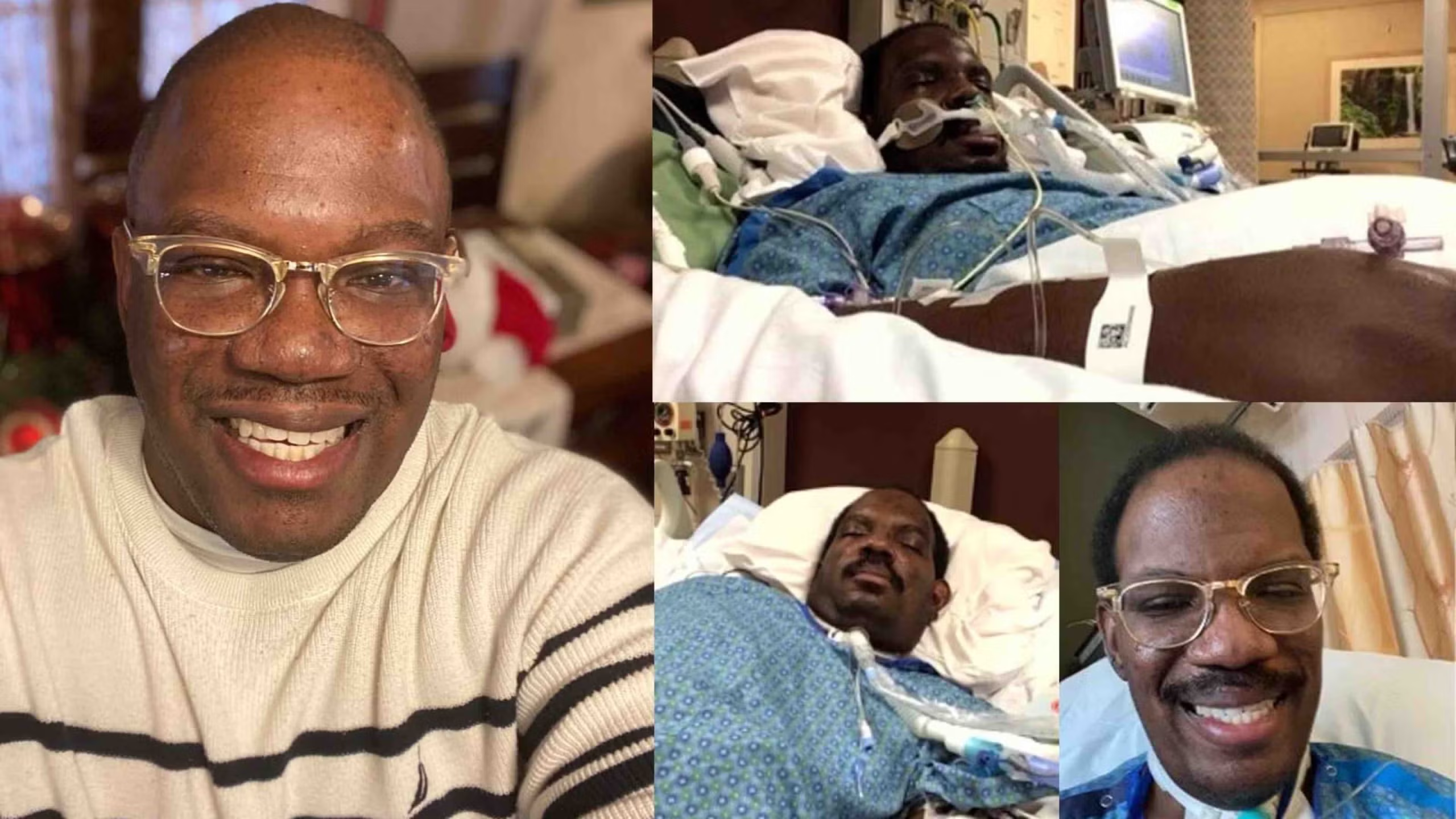
Last year, he survived COVID-19 after 59 days on a ventilator at M Health Fairview University of Minnesota Medical Center. He’s spent the past year recovering and sharing his experience – one of the most important and personal stories he’s ever told.
“It’s important for me to express gratitude and appreciation for the people who are risking their lives to take care of others,” said Byrd. He also hopes his story inspires other survivors and encourages people to protect themselves against the virus that nearly killed him.
“I was preparing myself in case anything happened.”
Byrd struggles with tuberous sclerosis, a rare genetic condition that causes high blood pressure and chronic pain, among other symptoms. M Health Fairview Internal Medicine Physician Heather Thompson Buum, MD, has been seeing Byrd for almost two decades. When the pandemic began, she encouraged him to exercise daily and get himself into the best shape possible.
Byrd practiced kickboxing and went for daily walks. When he couldn’t catch his breath climbing stairs in November 2020, he knew something was wrong. He called 911 and was brought to M Health Fairview University of Minnesota Medical Center with COVID-19.
“It progressed quickly from a stomach illness to pneumonia and then to needing ventilator support,” said Buum. “He had a severe illness, despite the fact that he’s fairly young and is only on a few medications for high blood pressure.”
Byrd stayed in the hospital for nearly two months on life support, from November 2020 to January 2021.
“It took time to figure out what I went through.”
Patients on life support are sedated. Byrd moved in and out of consciousness as a ventilator worked to provide air to his body. He doesn’t remember much between calling 911 and coming off the ventilator two months later.
“I remember a doctor saying I was cured. It felt like I was in a dream state, remembering the conversation,” said Byrd.
A difficult recovery process was just beginning. One year after being taken off the ventilator, Byrd is still working to get back to his personal and professional goals. He lost 40 pounds while in the hospital. It took time for him to regain strength and do even mundane tasks like showering or cooking.
“The first time I saw him, he needed a walker. It was an emotional moment for both of us,” said Buum. “Next time I saw him, he used a cane. The time after that, he used a walking stick and the time after that, he was finally walking on his own. It took months.”
Byrd returned to the hospital twice with complications from COVID-19. The first time for blood clots in his leg and the second time for a pulmonary embolism, a life-threatening clot in his lungs. Byrd also struggled through brain fog. He relied on Buum and M Health Fairview Psychologist William Robiner, PhD, ABPP, LP, to recover both physically and emotionally.
“What’s really impressive about Walter is his resolve. He’s someone who tries to see the good, not just focus on what’s been hard,” said Robiner. “If someone who was as sick as he was can recover, it makes you not want to give up hope.”
“You’re a huge inspiration to us right now.”
Registered Nurse Dawn Lenn, RN, cared for Byrd alongside her team in the ICU. Lenn and several other colleagues had just returned from three months at M Health Fairview Bethesda Hospital, which served as a dedicated COVID-19 facility during the start of the pandemic. Lenn recalled crying every day – both from grief and the overwhelming show of community support that healthcare workers received in the early days of the pandemic.
When Lenn returned to the medical center, she and her coworkers had been battling COVID-19 for months. Byrd was sedated and on life support by the time Lenn saw him. Still, over the weeks that followed the team got a sense of who he was. His family mentioned that Byrd’s phone was filled with missed calls and messages. Staff learned that he was someone who took care of and uplifted the other people in his life. When he was in the hospital, it took an especially hard toll on his community.
Byrd would eventually become a source of hope and positivity for frontline workers in the ICU, as he was for others. When he survived and came off the ventilator, doctors and nurses couldn’t wait to see him.
“‘You’re a huge inspiration to us right now,’ I told him,” Lenn said. “He started to get emotional. He said he didn’t realize he made such a difference in people’s lives.”
For Lenn, Byrd was an anomaly – one of the few people she’d seen survive after such severe illness. Byrd’s care team in the ICU was an inspiration to him, as well. The entire staff cheered as he walked again for the first time in months.
“They’ll remain in my heart always,” said Byrd. “I’m blessed to have been at the medical center.”
“More than anything, I want people to be informed.”
Byrd joined a team meeting before the holidays to thank his care team, almost a year after he was discharged from the ICU. He’s also returning to his creative projects and finding new ways to give back.
“It’s an important goal of mine to spread awareness. I’m working on several animation projects and down the line, I’d like to create a documentary on people who have dealt with COVID-19,” said Byrd.
He’s living proof of the grief and hope that can be found throughout the pandemic. After an incredibly difficult treatment and recovery period for both him and his family, he’s once again chasing his dreams and working to educate others about the risks of COVID-19.
“More than anything, I want people to be informed,” said Byrd. “You can die from this virus if you’re not taking precautions like getting vaccinated, wearing a mask, or social distancing. If you have doubts about something, confide in your physician.”
“Let’s everybody start rowing in the same direction,” said Robiner, “so we don’t have to have stories like this.”